LASERevz.200
200 lasers. One instrument. No two moments quite the same.
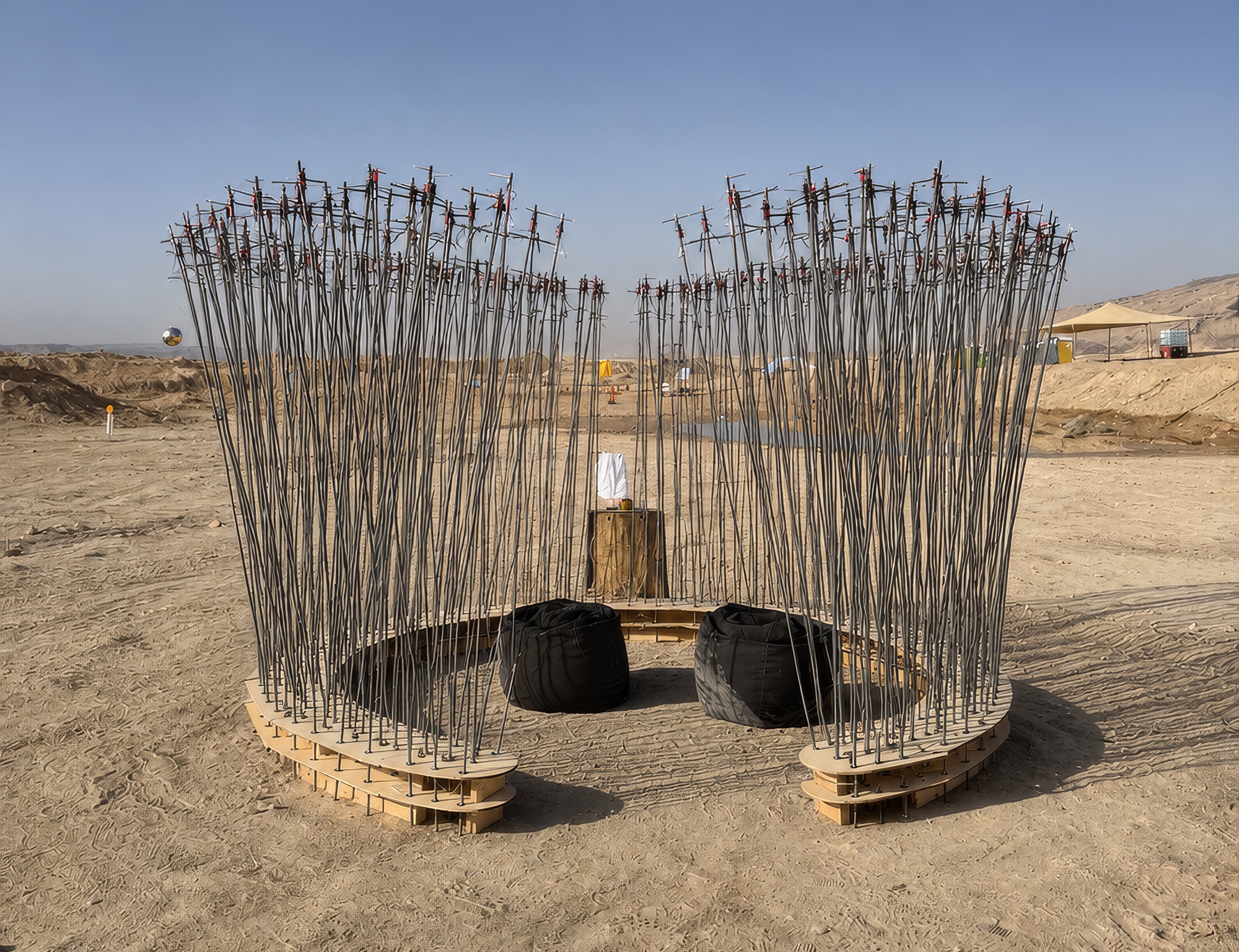
LASERevz.200 is an interactive light installation built from 200 individual laser units mounted on slender metal poles, arranged in a circular structure that surrounds its visitors. At first glance, it looks like a strange mechanical forest. But the structure is actually a musical instrument, a playground, and a performance system waiting to be discovered.
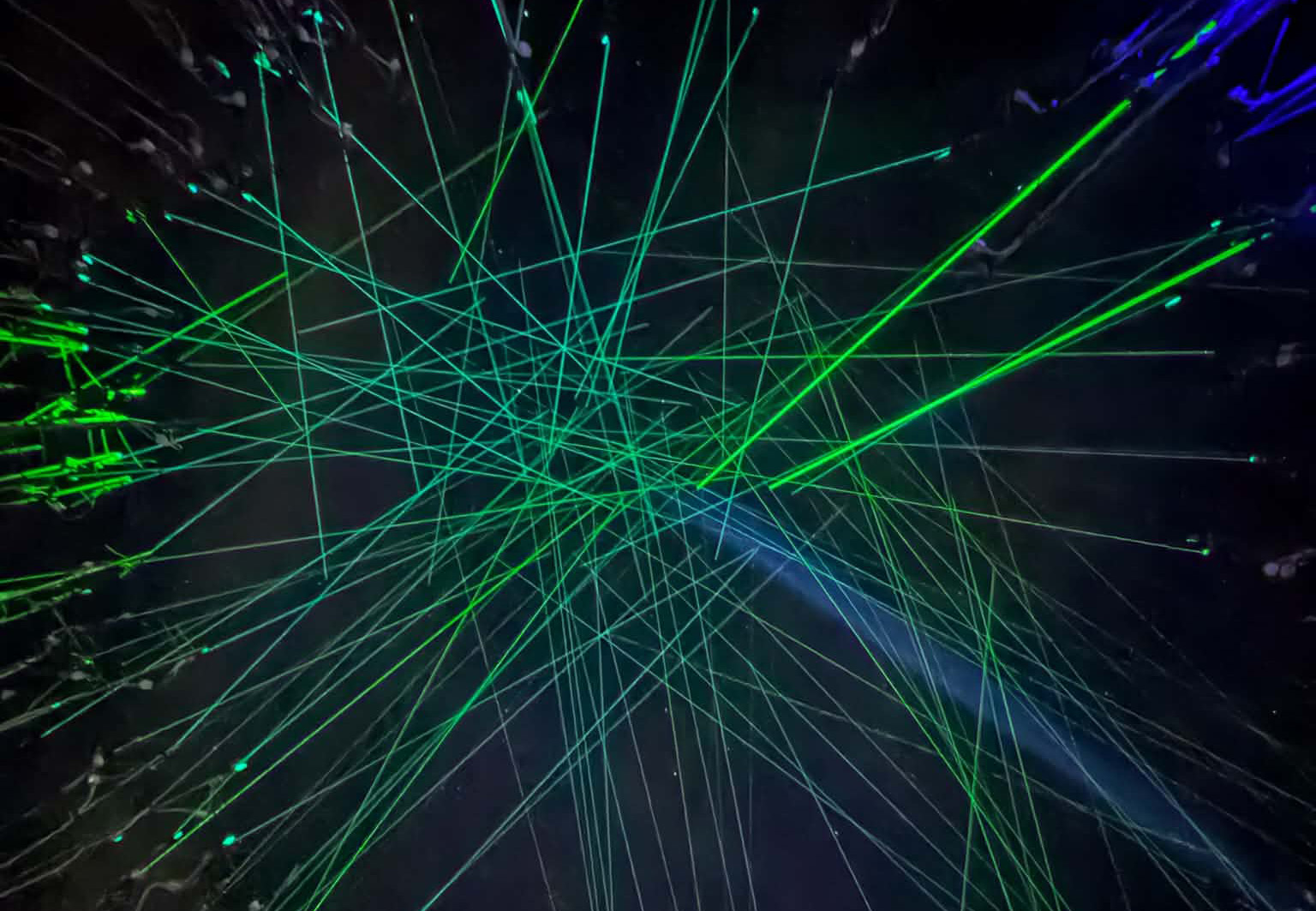
The installation is never entirely static. Hundreds of points of light switch on and off in carefully choreographed patterns, creating sequences that ripple, chase, pulse, collide, and unfold across the structure. Some movements are rhythmic and hypnotic; others are chaotic, unexpected, or deliberately overwhelming. The result is a constantly changing landscape of light, somewhere between a kinetic sculpture, a laser show, and an interactive game.
You are part of the instrument
LASERevz.200 invites visitors to take control.
A joystick mounted on the control system acts as the main interface. Visitors can move between visual sequences, change their speed, pause the performance, and influence how the installation behaves. The system contains 30 original lighting sequences, each with its own character, rhythm, and choreography.
But the controls go further than a conventional interface. The number and rhythm of clicks matter. A single click pauses or resumes the performance. Other gestures change playback modes, activate special performances, or reveal hidden features.
There is also a large external red button. It looks like an emergency stop, but it has a second identity. Pressing it opens a short interaction window in which visitors can trigger a miniature game or unlock secret performances.
The installation rewards curiosity. There is no instruction manual beside it. The interface is simple, but its possibilities are not immediately obvious.
Under the hood: 200 lasers, 40 channels, one brain
Behind the visual complexity is a custom-built electronic control system.
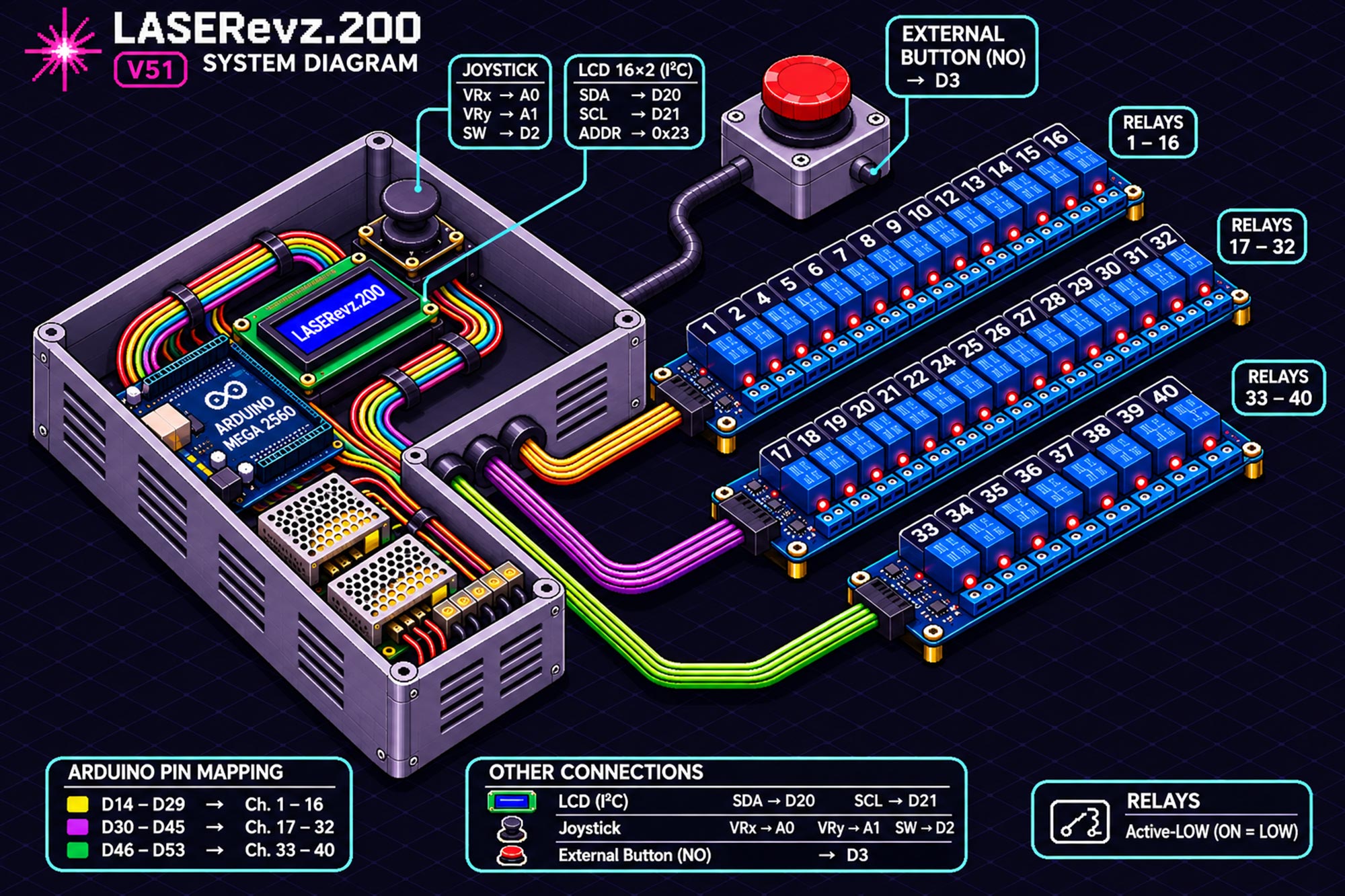
The installation uses an Arduino Mega 2560 as its central controller, connected to 40 relay channels that orchestrate the 200 laser units. The lasers are divided into three groups:
Small lasers: 33 channels, forming the main visual vocabulary.
Palm lasers: 4 channels, adding stronger visual accents.
Big lasers: 3 channels, reserved for selected dramatic moments.
The controller manages timing, sequencing, switching patterns, interaction logic, and performance modes. A custom joystick interface and a 16×2 LCD provide direct access to the system’s functions and display its current state.
Rather than simply turning everything on and off at random, the system runs programmed sequences with different movement patterns, densities, speeds, and combinations of laser groups. Some sequences move back and forth; others create continuous circular motion. The system can automatically advance between sequences or remain on a selected one.
Music introduces another layer. Special performances are built around MIDI-derived timing, translating musical events into relay choreography. Notes become pulses of light, rhythmic patterns become movement, and selected musical peaks are emphasized with the more powerful laser groups.
The hardware is deliberately straightforward. The complexity lives in the choreography.
Easter eggs: there is more than meets the eye
LASERevz.200 has a hidden personality. Beyond its regular sequences are secret performances and unexpected interactions that can be discovered through combinations of clicks and button presses.
The Mountain King
A familiar classical composition is transformed into a laser performance. Triggered through a special joystick gesture, the installation follows an excerpt inspired by In the Hall of the Mountain King, translating its escalating musical tension into increasingly animated light patterns.
The Imperial March
For those who know the right gesture, the Dark Side is waiting. A hidden performance based on the iconic Imperial March transforms the installation into a synchronized light orchestra. Small lasers establish the rhythm, palm lasers punctuate the musical phrases, and the big lasers appear at selected dramatic peaks.
Minigame 1: Let’s Play
The red button hides a game. Three small lasers rotate through the installation at increasingly challenging speeds. The visitor must press the button at precisely the right moment, when the active group reaches a particular target. Get it right, and a secret performance is unlocked. Miss three times, and the regular show returns.
The secret handshake
The red button has its own hidden language. A long press initiates a confirmation sequence, followed by a specific number of short presses to choose between secret performances. The joystick has its own combinations, too. Some functions are easy to stumble upon; others require a little persistence.
These are not simply extra effects. They turn the installation into something that can be explored, learned, and played with.
An instrument disguised as a sculpture
LASERevz.200 blurs the boundaries between sculpture, technology, light art, music, and play. Its physical structure gives it the appearance of an engineered object, while its behavior introduces something unpredictable and almost alive.
It is designed to be experienced from within and around it. Visitors are not only watching a performance; they are given the opportunity to influence it, interrupt it, speed it up, slow it down, and uncover things that are not immediately visible.
Two hundred lasers, a custom electronic brain, a handful of controls, and a few secrets.
The rest is up to the audience.